I have heard that some of you are not getting the posts by e-mail after attempting to subscribe, and as I check the subscription lists several of you are "unverified".
To subscribe by e-mail takes a few quick steps.
The first step is to click on the button "Subscribe By E-Mail."
The second step is to enter the letters you see into the box below; this is done to prevent spammers from using automated systems to sign up.
The third step is the most important. You will receive an e-mail asking to verify that you do indeed want to subscribe. If you do not respond to this, your subscription will not be activated.
E-mail me at Dr.Moore@SurvivingtheSuffering if you have any problems.
Thank you.
Tuesday, September 24, 2013

Monday, September 16, 2013
O.K. You're Human. So What?
We have spent the last several weeks looking at what it means to be human and the lethal consequences when society declares a person or group of people "not quite human". In the case of Nazi Germany, the declaration of the Jew as "sub-human" led to the slaughter of over six million people during World War II. Because many have declared the fetus to be not quite human, over fifty million abortions have been performed in the United States in the last forty years. Still, the truth of humanity cannot be suppressed forever. In horror, people look back on the Holocaust and wonder how the Jews could have been thought of in that way. And it is getting harder and harder to look at the unborn child and say that it is not human.
Where I think we may be headed is an even darker place than the land of untruth. It is the land of uncaring. It may be that modern society recognizes the unborn as a real bona fide human being, but then sees no problem with killing them. When we last looked at late term abortions, we discussed the partial birth abortion, where an unborn child is partially extracted from the womb and then killed before fully removing it. That practice has been illegal since the Partial Birth Abortion Ban Act of 2003. But late term abortions are still performed. The law said you could not extract a live fetus. It didn't say anything about killing the fetus and then extracting it. The current procedure now is to use a long needle and inject digitalis into the unborn baby's heart, killing it, and then it is dismembered, removed, and discarded.
If you remember our discussion in Part III, we talked about the Nazi euthanasia program, Aktion T4. The Nazis decided that the "unfit" did not deserve to live and they began putting "defective" infants to death in 1939. This was expanded to older children and then adults. Over 70,000 German citizens were killed in this program. When the German public at large became aware of what was going on, there was an outcry and the protests forced the Nazi leadership to officially abandon the program, although it was continued in secret for several more years.
Today, euthanasia is making a comeback in the modern world, and there is no secrecy and no protest. To be clear in our discussions, we must make a distinction between euthanasia and physician-assisted suicide. In the latter, the physician gives to the patient the fatal medicine, and the patient takes it himself. In euthanasia, the physician actually administers the lethal poison to the patient. Both physician-assisted suicide and euthanasia are now legal in the Netherlands, Belgium, and Luxembourg; all three countries were defeated in World War II by the Nazis and opposed them. They are now embracing Nazi euthanasia ideology.
On this side of the Atlantic, Quebec seems likely to be the first to blaze the euthanasia trail, as they have considered legalizing it with Bill 52. We do not have euthanasia in the United States, but physician-assisted suicide is legal in Washington, Oregon, Vermont, and essentially in Montana. We have not yet caught up with Europe, but there is still time.
Well, what if someone is suffering and wants to die? Why should we care if someone submits to voluntary euthanasia? They are only harming themselves, and they should make the decision about how and when to end their life, right?
What if the euthanasia, like the Nazi T4 program, was involuntary?
I am sure that you think that such a thing does not exist. I would like to refer you to the Groningen Protocol from the Netherlands. It was published in the New England Journal of Medicine and is referenced below. It describes in great detail the selection process for putting infants to death in that country. It requires a very smart and dedicated team of physicians and health care workers who evaluate the infant and determine that it should be euthanized. Belgium liked the way the Dutch were doing things so much that they took the Protocol and fashioned a bill to take to their parliament last November, and it now seems close to passing. The Belgians are likely to expand euthanasia to those with Alzheimer's disease and dementia, and a report in the Canadian Medical Association Journal suggests that already nearly a third of euthanasia cases in that country do not involve a patient request. According to the British Medical Journal, a fifth of cases in the Netherlands do not involve a patient request. Although involuntary euthanasia is currently illegal in all countries (with the exception of the Groningen Protocol babies), it continues to be practiced, not prosecuted. The right of a human to put himself to death or to request to be put to death becomes the right to put the human to death.
Personal choice, not God's sovereignty, seems paramount these days. Someone has to choose in these matters: the mother aborting her child, the patient requesting assisted suicide, or the doctors practicing involuntary euthanasia make a choice. The fetus whose heart is being injected with digitalis, however, does not get to choose, nor does the baby being examined by the doctors under the Groningen Protocol or the patient with Alzheimer's who is euthanized. What happens when the state starts making the choice? Under China's One-Child Policy, three hundred and thirty-six million abortions have been performed since 1971, many of which were forced. And in Western Civilization, we have the National Health Service in England and its Liverpool Care Pathway. Although it is not euthanasia, it involves withdrawing food and water from patients the NHS health care team decides are not long for this world. It turns out that of conscious patients, half are not told this will be done to them. If I recall correctly, the choosing of the time of one's death is to be done by God.
So we try very hard to get these people recognized as human, and even if we succeed, it won't matter because human life is becoming devalued. We can convince a society through evidence and reasoning that these people are human, but we cannot force a society to value human life. We talked last week about the "collapse clause" in the Roe v. Wade decision, where it was stated that if the fetus could be shown to be a person, the argument for abortion would collapse, and the fetus would be protected under the Fourteenth Amendment. That Amendment states that no one may be deprived of life without "due process of law". Well, look at the Groningen Protocol and the Liverpool Care Pathway, and there is your due process.
Thinking of these things as medical "procedures" seems to make them so much more acceptable, and even dignified. As I mentioned in an article earlier this year ("What's Your Life Worth, Anyway"), I am unable to find anywhere in the Bible a passage on death with dignity. It is interesting that often those who are proponents of death with dignity are also supporters of abortion. I cannot think of a less dignified way to die than to be scraped and torn apart in the womb. The Jew facing the brutal Nazi gas chambers declares, "I am not a sub-human!" The fetus inside its mother pleads "I am human!" The Chinese mother facing forced abortion cries, "My baby is human!" The elderly person with dementia implores, "I am still human!" And before the fatal procedure is administered, the last thing they hear is "You're absolutely right. But we don't care."
1. Verhagen, E, and Sauer, JJ. The Groningen Protocol--Euthanasia in Severely Ill Newborns. New Eng J Med 2005;352:959-62.
2. Chambaere, K, Bilsen, J, Cohen, J, et. al. Physician Assisted Deaths Under the Euthanasia Law in Belgium: A Population-Based Survey. CMAJ 2010;1-7.
3. van der Wal, G, and Dillman, RJ. Euthanasia in the Netherlands. British Med J 1994;308:1346-9.
4. http://www.dailymail.co.uk/news/article-2255054/60-000-patients-death-pathway-told-minister-says-controversial-end-life-plan-fantastic.html.
Where I think we may be headed is an even darker place than the land of untruth. It is the land of uncaring. It may be that modern society recognizes the unborn as a real bona fide human being, but then sees no problem with killing them. When we last looked at late term abortions, we discussed the partial birth abortion, where an unborn child is partially extracted from the womb and then killed before fully removing it. That practice has been illegal since the Partial Birth Abortion Ban Act of 2003. But late term abortions are still performed. The law said you could not extract a live fetus. It didn't say anything about killing the fetus and then extracting it. The current procedure now is to use a long needle and inject digitalis into the unborn baby's heart, killing it, and then it is dismembered, removed, and discarded.
If you remember our discussion in Part III, we talked about the Nazi euthanasia program, Aktion T4. The Nazis decided that the "unfit" did not deserve to live and they began putting "defective" infants to death in 1939. This was expanded to older children and then adults. Over 70,000 German citizens were killed in this program. When the German public at large became aware of what was going on, there was an outcry and the protests forced the Nazi leadership to officially abandon the program, although it was continued in secret for several more years.
Today, euthanasia is making a comeback in the modern world, and there is no secrecy and no protest. To be clear in our discussions, we must make a distinction between euthanasia and physician-assisted suicide. In the latter, the physician gives to the patient the fatal medicine, and the patient takes it himself. In euthanasia, the physician actually administers the lethal poison to the patient. Both physician-assisted suicide and euthanasia are now legal in the Netherlands, Belgium, and Luxembourg; all three countries were defeated in World War II by the Nazis and opposed them. They are now embracing Nazi euthanasia ideology.
On this side of the Atlantic, Quebec seems likely to be the first to blaze the euthanasia trail, as they have considered legalizing it with Bill 52. We do not have euthanasia in the United States, but physician-assisted suicide is legal in Washington, Oregon, Vermont, and essentially in Montana. We have not yet caught up with Europe, but there is still time.
Well, what if someone is suffering and wants to die? Why should we care if someone submits to voluntary euthanasia? They are only harming themselves, and they should make the decision about how and when to end their life, right?
What if the euthanasia, like the Nazi T4 program, was involuntary?
I am sure that you think that such a thing does not exist. I would like to refer you to the Groningen Protocol from the Netherlands. It was published in the New England Journal of Medicine and is referenced below. It describes in great detail the selection process for putting infants to death in that country. It requires a very smart and dedicated team of physicians and health care workers who evaluate the infant and determine that it should be euthanized. Belgium liked the way the Dutch were doing things so much that they took the Protocol and fashioned a bill to take to their parliament last November, and it now seems close to passing. The Belgians are likely to expand euthanasia to those with Alzheimer's disease and dementia, and a report in the Canadian Medical Association Journal suggests that already nearly a third of euthanasia cases in that country do not involve a patient request. According to the British Medical Journal, a fifth of cases in the Netherlands do not involve a patient request. Although involuntary euthanasia is currently illegal in all countries (with the exception of the Groningen Protocol babies), it continues to be practiced, not prosecuted. The right of a human to put himself to death or to request to be put to death becomes the right to put the human to death.
Personal choice, not God's sovereignty, seems paramount these days. Someone has to choose in these matters: the mother aborting her child, the patient requesting assisted suicide, or the doctors practicing involuntary euthanasia make a choice. The fetus whose heart is being injected with digitalis, however, does not get to choose, nor does the baby being examined by the doctors under the Groningen Protocol or the patient with Alzheimer's who is euthanized. What happens when the state starts making the choice? Under China's One-Child Policy, three hundred and thirty-six million abortions have been performed since 1971, many of which were forced. And in Western Civilization, we have the National Health Service in England and its Liverpool Care Pathway. Although it is not euthanasia, it involves withdrawing food and water from patients the NHS health care team decides are not long for this world. It turns out that of conscious patients, half are not told this will be done to them. If I recall correctly, the choosing of the time of one's death is to be done by God.
So we try very hard to get these people recognized as human, and even if we succeed, it won't matter because human life is becoming devalued. We can convince a society through evidence and reasoning that these people are human, but we cannot force a society to value human life. We talked last week about the "collapse clause" in the Roe v. Wade decision, where it was stated that if the fetus could be shown to be a person, the argument for abortion would collapse, and the fetus would be protected under the Fourteenth Amendment. That Amendment states that no one may be deprived of life without "due process of law". Well, look at the Groningen Protocol and the Liverpool Care Pathway, and there is your due process.
Thinking of these things as medical "procedures" seems to make them so much more acceptable, and even dignified. As I mentioned in an article earlier this year ("What's Your Life Worth, Anyway"), I am unable to find anywhere in the Bible a passage on death with dignity. It is interesting that often those who are proponents of death with dignity are also supporters of abortion. I cannot think of a less dignified way to die than to be scraped and torn apart in the womb. The Jew facing the brutal Nazi gas chambers declares, "I am not a sub-human!" The fetus inside its mother pleads "I am human!" The Chinese mother facing forced abortion cries, "My baby is human!" The elderly person with dementia implores, "I am still human!" And before the fatal procedure is administered, the last thing they hear is "You're absolutely right. But we don't care."
1. Verhagen, E, and Sauer, JJ. The Groningen Protocol--Euthanasia in Severely Ill Newborns. New Eng J Med 2005;352:959-62.
2. Chambaere, K, Bilsen, J, Cohen, J, et. al. Physician Assisted Deaths Under the Euthanasia Law in Belgium: A Population-Based Survey. CMAJ 2010;1-7.
3. van der Wal, G, and Dillman, RJ. Euthanasia in the Netherlands. British Med J 1994;308:1346-9.
4. http://www.dailymail.co.uk/news/article-2255054/60-000-patients-death-pathway-told-minister-says-controversial-end-life-plan-fantastic.html.
Sunday, September 15, 2013
Not Quite Human, Part V
We have spent the last several weeks looking at what happens when a society declares some of its members "sub-human" or "non-human", as in the case in Nazi Germany and the Jews in World War II. A mood of anti-Semitism that had been present for many generations was transformed into a new truth over the course of only a few generations by continuous teaching and preaching-- that Jews were not human. This led to the slaughter of over six million people that were previously acknowledged by the Germans to be human and certainly following the Holocaust are clearly known to be human today. The horrible abuse inflicted on the Jews will never be forgotten, even by the Germans, where denying the reality of the Holocaust today is actually a criminal offense, punishable by imprisonment for three months to five years.
We would think that something as simple as the definition of a human being would be straightforward and not open to change or debate. Yet we saw an entire country change the meaning of human being for several decades and then change it back. Something so simple as a change in definition lead to the deaths of millions. Today, we have over a million abortions performed in the United States, in part because the fetus is not defined as a human being.
Most people would agree with the following premise:
An innocent human being must not be killed
The qualifier "innocent" is used here because the state has the authority to take the life of someone who is found guilty of a capital crime. Furthermore, if it is established that the fetus is human, it clearly is innocent. Therefore, for the sake of simplicity, we will leave out the term "innocent."
All arguments against abortion must destroy both halves of this premise, which can be restated as:
If it is a human being, it must not be killed.
Either half of this premise can be attacked. You can argue that the fetus is not a human being. Or, you can argue that it is acceptable to kill human beings. In fact, both sides of this premise are regularly assaulted by its pro-abortion opponents. Today, we will look at the attacks on the fetus as a human being; next week we will study the other half of the premise.
For many decades now, it has been argued that the fetus is not a human being. In fact, this was one of the foundational definitional issues in the Roe v. Wade decision made by the U. S. Supreme Court in 1973. In fact, the decision has within it what is known as the "collapse clause", which states, "If this suggestion of personhood is established, the appellant's case, of course collapses, for the fetus' right to life would be guaranteed specifically by the (Fourteenth) Amendment." It was the interpretation of those Justices that voted in favor of the decision that the fetus was not a person or human being. In fact, they noted that "...the law has been reluctant to endorse any theory that life, as we recognize it, begins before live birth..." (emphasis mine).
If you are secure in your knowledge that a portion of a premise is false, there is no need to attack the other portion. In fact, to do so makes it appear that you may not really be so certain about your position. If it is absolutely true that the fetus is not a person, then there is no need to make any attacks on the portion of the premise that states that "it must not be killed." In other words, if a fetus is truly not a person, then there should be no issue whatsoever in destroying it. You do not need to make any arguments about women having a right to choice, women having the right to control their own bodies, or women having the right to "reproductive rights." Likewise, if it is acceptable to kill human beings, based on women's choice, control, or reproductive rights, then there is no need to spend so much effort claiming that the fetus is not human.
The primary problem faced by the pro-abortion crowd today is that the fetus is increasingly being recognized as a human being. Advancing medical science has demonstrated several things in this regard. Over and over again it is shown that the fetus has a functioning heart within six weeks of conception, brain waves can be detected at eight weeks, fetal breathing movements at ten weeks, and body movement begins at twelve weeks. It is difficult to claim that this is not human life.
For the vast majority of people, their death, when they cease to be a living human being, will be determined when their heart stops beating. For a few who are kept alive by life support devices, their death will be determined by when their brain waves cease, or "brain death." As a cardiac surgeon, I am very well acquainted with the beating and still heart and occasionally have been involved in brain death cases, usually where issues of organ donation for transplantation were involved. If it is accepted that cardiac standstill or brain death denotes the death of a human, it would stand to reason that evidence of a heartbeat or brain waves indicates that human life is present.
The second area where advancing medical science has changed the whole notion of life has to do with the changing notion of viability. Premature infants less than twenty-two weeks gestational age are now surviving. The law may not recognize life until after live birth, but these small infants, that could fit into the palm of your hand, are clearly not recognizing the law. The Supreme Court, in 1973, thought viability was established at twenty-eight weeks, a difference of a month-and-a-half from current viability. You cannot incorporate the concept of viability into the definition of a human being when you do not know when that viability occurs.
When does this human life begin? The notion of a "trimester" is a man-made creation; we arbitrarily take the 39 weeks of gestation and divide it into 13-week thirds. The developing fetus does not recognize this systematic nomenclature. From the time of conception until the baby takes its first breath and cries, there is a seamless and undivided progress from embryo to fetus to child. There is no point where you can say that this is not a human life today and then say it is a human life the next day.
We have been looking at the development of the fetus in a forwards direction; let us now do so in a reverse manner. To do so will involve some gruesome and explicit terms, but this is what has been done and is being done in this country. Most people would agree that to murder an infant is illegal, immoral, and unacceptable. However, the United States had to actually pass a law, in 2002, the Born-Alive Infants Protection Act, to give legal protection to live babies that had survived abortions.
Yet up until 2003, it was legal to perform partial birth abortions, medically known as "intact dilation and extraction." In that procedure, an infant yet to be born was turned around in its mother's womb until the feet were grasped and the infant is pulled part of the way out of the vaginal canal. The infant is extracted until only the head remains inside. At that point the base of the skull is punctured and the brains are suctioned out, killing the infant and allowing the skull to collapse. The dead child is now delivered. The key component here was the abortion doctor's thumb, which held the skull inside the vaginal canal while it was punctured and suctioned. If his thumb slipped, the head would be delivered and he would now have a live baby in his hands. The six inches of the vaginal canal, the distance the head would travel, changed the definition of the child from unborn fetus, which seemingly was not yet human and had no rights, to that of live infant, with all the rights of any human. Today, although partial birth abortions are illegal, late term abortions are performed up until 35 weeks of gestation.
What the fetus doesn't know can kill it. The twenty one week old fetus doesn't know that if he can hang in there just one more week he might be viable and therefore human in the eyes of some. The late term fetus undergoing a partial birth abortion, feeling the cool air on his body, arms and legs, didn't know that while his head was warm and still inside his mother that his skull was about to be punctured because he wasn't quite human yet.
The Bible does not talk about "viability" and "trimesters." Psalm 139:13 says, "For you formed my inward parts; you knitted me together in my mother's womb. I praise you, for I am fearfully and wonderfully made." Even further, in Jeremiah 1:5, we are told that God said, "Before I formed you in the womb I knew you." God knew us as people, as humans, from the very moment we were conceived. He doesn't say that He only knew us after we became viable or exited the birth canal. Everything that makes us human, every gene and chromosome, is present from the moment of conception.
However, being a human may not be enough. There are many who do not believe human life is sacred. As we began this series, we looked at Genesis 9:5-6, "Surely for your lifeblood I will demand a reckoning, from the hand of every beast I will require it and from the hand of man. From the hand of every man's brother I will require the life of man. Whoever sheds man's blood, by man his blood shall be shed; for in the image of God He made man." Man's life is special and belongs to God alone. Man plays God when he decides who gets to be human and when, and he plays God when he decides which life should be ended and when. The latter we will look at next week.
By defining Jews as not quite human, Germany was able to justify killing six million of them. By defining the fetus as not quite human, America has been able to justify killing over fifty million babies since 1973. Just as the Jews reclaimed their humanity from their horrible suffering, our unborn children may yet one day reclaim their humanity after losing millions of their unborn brothers and sisters.
We would think that something as simple as the definition of a human being would be straightforward and not open to change or debate. Yet we saw an entire country change the meaning of human being for several decades and then change it back. Something so simple as a change in definition lead to the deaths of millions. Today, we have over a million abortions performed in the United States, in part because the fetus is not defined as a human being.
Most people would agree with the following premise:
An innocent human being must not be killed
The qualifier "innocent" is used here because the state has the authority to take the life of someone who is found guilty of a capital crime. Furthermore, if it is established that the fetus is human, it clearly is innocent. Therefore, for the sake of simplicity, we will leave out the term "innocent."
All arguments against abortion must destroy both halves of this premise, which can be restated as:
If it is a human being, it must not be killed.
Either half of this premise can be attacked. You can argue that the fetus is not a human being. Or, you can argue that it is acceptable to kill human beings. In fact, both sides of this premise are regularly assaulted by its pro-abortion opponents. Today, we will look at the attacks on the fetus as a human being; next week we will study the other half of the premise.
For many decades now, it has been argued that the fetus is not a human being. In fact, this was one of the foundational definitional issues in the Roe v. Wade decision made by the U. S. Supreme Court in 1973. In fact, the decision has within it what is known as the "collapse clause", which states, "If this suggestion of personhood is established, the appellant's case, of course collapses, for the fetus' right to life would be guaranteed specifically by the (Fourteenth) Amendment." It was the interpretation of those Justices that voted in favor of the decision that the fetus was not a person or human being. In fact, they noted that "...the law has been reluctant to endorse any theory that life, as we recognize it, begins before live birth..." (emphasis mine).
If you are secure in your knowledge that a portion of a premise is false, there is no need to attack the other portion. In fact, to do so makes it appear that you may not really be so certain about your position. If it is absolutely true that the fetus is not a person, then there is no need to make any attacks on the portion of the premise that states that "it must not be killed." In other words, if a fetus is truly not a person, then there should be no issue whatsoever in destroying it. You do not need to make any arguments about women having a right to choice, women having the right to control their own bodies, or women having the right to "reproductive rights." Likewise, if it is acceptable to kill human beings, based on women's choice, control, or reproductive rights, then there is no need to spend so much effort claiming that the fetus is not human.
The primary problem faced by the pro-abortion crowd today is that the fetus is increasingly being recognized as a human being. Advancing medical science has demonstrated several things in this regard. Over and over again it is shown that the fetus has a functioning heart within six weeks of conception, brain waves can be detected at eight weeks, fetal breathing movements at ten weeks, and body movement begins at twelve weeks. It is difficult to claim that this is not human life.
For the vast majority of people, their death, when they cease to be a living human being, will be determined when their heart stops beating. For a few who are kept alive by life support devices, their death will be determined by when their brain waves cease, or "brain death." As a cardiac surgeon, I am very well acquainted with the beating and still heart and occasionally have been involved in brain death cases, usually where issues of organ donation for transplantation were involved. If it is accepted that cardiac standstill or brain death denotes the death of a human, it would stand to reason that evidence of a heartbeat or brain waves indicates that human life is present.
The second area where advancing medical science has changed the whole notion of life has to do with the changing notion of viability. Premature infants less than twenty-two weeks gestational age are now surviving. The law may not recognize life until after live birth, but these small infants, that could fit into the palm of your hand, are clearly not recognizing the law. The Supreme Court, in 1973, thought viability was established at twenty-eight weeks, a difference of a month-and-a-half from current viability. You cannot incorporate the concept of viability into the definition of a human being when you do not know when that viability occurs.
When does this human life begin? The notion of a "trimester" is a man-made creation; we arbitrarily take the 39 weeks of gestation and divide it into 13-week thirds. The developing fetus does not recognize this systematic nomenclature. From the time of conception until the baby takes its first breath and cries, there is a seamless and undivided progress from embryo to fetus to child. There is no point where you can say that this is not a human life today and then say it is a human life the next day.
We have been looking at the development of the fetus in a forwards direction; let us now do so in a reverse manner. To do so will involve some gruesome and explicit terms, but this is what has been done and is being done in this country. Most people would agree that to murder an infant is illegal, immoral, and unacceptable. However, the United States had to actually pass a law, in 2002, the Born-Alive Infants Protection Act, to give legal protection to live babies that had survived abortions.
Yet up until 2003, it was legal to perform partial birth abortions, medically known as "intact dilation and extraction." In that procedure, an infant yet to be born was turned around in its mother's womb until the feet were grasped and the infant is pulled part of the way out of the vaginal canal. The infant is extracted until only the head remains inside. At that point the base of the skull is punctured and the brains are suctioned out, killing the infant and allowing the skull to collapse. The dead child is now delivered. The key component here was the abortion doctor's thumb, which held the skull inside the vaginal canal while it was punctured and suctioned. If his thumb slipped, the head would be delivered and he would now have a live baby in his hands. The six inches of the vaginal canal, the distance the head would travel, changed the definition of the child from unborn fetus, which seemingly was not yet human and had no rights, to that of live infant, with all the rights of any human. Today, although partial birth abortions are illegal, late term abortions are performed up until 35 weeks of gestation.
What the fetus doesn't know can kill it. The twenty one week old fetus doesn't know that if he can hang in there just one more week he might be viable and therefore human in the eyes of some. The late term fetus undergoing a partial birth abortion, feeling the cool air on his body, arms and legs, didn't know that while his head was warm and still inside his mother that his skull was about to be punctured because he wasn't quite human yet.
The Bible does not talk about "viability" and "trimesters." Psalm 139:13 says, "For you formed my inward parts; you knitted me together in my mother's womb. I praise you, for I am fearfully and wonderfully made." Even further, in Jeremiah 1:5, we are told that God said, "Before I formed you in the womb I knew you." God knew us as people, as humans, from the very moment we were conceived. He doesn't say that He only knew us after we became viable or exited the birth canal. Everything that makes us human, every gene and chromosome, is present from the moment of conception.
However, being a human may not be enough. There are many who do not believe human life is sacred. As we began this series, we looked at Genesis 9:5-6, "Surely for your lifeblood I will demand a reckoning, from the hand of every beast I will require it and from the hand of man. From the hand of every man's brother I will require the life of man. Whoever sheds man's blood, by man his blood shall be shed; for in the image of God He made man." Man's life is special and belongs to God alone. Man plays God when he decides who gets to be human and when, and he plays God when he decides which life should be ended and when. The latter we will look at next week.
By defining Jews as not quite human, Germany was able to justify killing six million of them. By defining the fetus as not quite human, America has been able to justify killing over fifty million babies since 1973. Just as the Jews reclaimed their humanity from their horrible suffering, our unborn children may yet one day reclaim their humanity after losing millions of their unborn brothers and sisters.
Sunday, September 8, 2013
Not Quite Human, Part IV
We return now after a few weeks to look at what happens when a society declares a group of people to be "sub-human" as well as the source of problems in that society. We have seen how the Jewish people came to be despised in Germany, with full-blown anti-Semitism developing by the early twentieth century. We followed this as it developed into all forms of persecution, closing Jewish businesses and resulting in beatings and other abuse. Kristallnacht in 1938 was one of the culminations of generations of Germans who had been taught of the evil and sub-human Jew.
Most Jews who could leave Germany did so, and less than half a million remained by the beginning of the second World War in 1939. By that time, Hitler and his physicians had already begun the process of mass extermination of infants and small children that they had deemed "unfit". First with chemicals, those selected to die were involuntarily euthanized, and when chemicals proved to be too expensive and inefficient, carbon monoxide gas was used. Having begun solving one "problem", that of the "undesirable" children (and later adults), the Nazi leadership began to work on the much larger "Jewish problem". It was after the onset of World War II, with the invasion of Poland and Eastern Europe, that there were large numbers of Jews that came under Nazi control.
During that first year of the war, Jewish people were required to be identified and wear a yellow star. many Jews were sent to concentration camps. Initially, these camps were simply holding places, although forced labor was required. A portion of Warsaw was walled off, the "Ghetto", where living conditions with starvation and disease all but precluded survival. The real effort at exterminating the Jews, however, began not in these camps and ghettos, but in the villages and towns throughout Poland. The Nazis organized Einsatzgruppen from the Schutzstaffel, (or "SS" as it is commonly known) for the purpose of disposing of Jews in the newly conquered territories. I must warn you that the following material is quite graphic.
These Einsatzgruppen roamed the Polish countryside, raiding homes and farms and businesses. The men and women, boys and girls, young and old were usually rounded up to some central location and then shot. The mass killings were usually performed by having the victims lie prone and then receive a bullet to the back of the head. Hundreds and then thousands of these executions were performed. The killings were not restricted to Einsatzgruppen, however. Even ordinary German citizens who were too old or unfit to serve as soldiers worked in police squads that were employed for the work of eliminating Jews. If a Jew was found in a home or hospital and was too weak or ill to make it to the killing site, they were simply shot in bed. If they escaped to the surrounding countryside or forest, they were hunted down. As opposed to firing at enemy soldiers across a battlefield, innocent people had the backs of their heads blown off at close range. The killers were frequently covered with blood, brains, and skull fragments. All in a day's work, I suppose. Get cleaned up and go out the next day to start another job.


Most Jews who could leave Germany did so, and less than half a million remained by the beginning of the second World War in 1939. By that time, Hitler and his physicians had already begun the process of mass extermination of infants and small children that they had deemed "unfit". First with chemicals, those selected to die were involuntarily euthanized, and when chemicals proved to be too expensive and inefficient, carbon monoxide gas was used. Having begun solving one "problem", that of the "undesirable" children (and later adults), the Nazi leadership began to work on the much larger "Jewish problem". It was after the onset of World War II, with the invasion of Poland and Eastern Europe, that there were large numbers of Jews that came under Nazi control.
During that first year of the war, Jewish people were required to be identified and wear a yellow star. many Jews were sent to concentration camps. Initially, these camps were simply holding places, although forced labor was required. A portion of Warsaw was walled off, the "Ghetto", where living conditions with starvation and disease all but precluded survival. The real effort at exterminating the Jews, however, began not in these camps and ghettos, but in the villages and towns throughout Poland. The Nazis organized Einsatzgruppen from the Schutzstaffel, (or "SS" as it is commonly known) for the purpose of disposing of Jews in the newly conquered territories. I must warn you that the following material is quite graphic.
These Einsatzgruppen roamed the Polish countryside, raiding homes and farms and businesses. The men and women, boys and girls, young and old were usually rounded up to some central location and then shot. The mass killings were usually performed by having the victims lie prone and then receive a bullet to the back of the head. Hundreds and then thousands of these executions were performed. The killings were not restricted to Einsatzgruppen, however. Even ordinary German citizens who were too old or unfit to serve as soldiers worked in police squads that were employed for the work of eliminating Jews. If a Jew was found in a home or hospital and was too weak or ill to make it to the killing site, they were simply shot in bed. If they escaped to the surrounding countryside or forest, they were hunted down. As opposed to firing at enemy soldiers across a battlefield, innocent people had the backs of their heads blown off at close range. The killers were frequently covered with blood, brains, and skull fragments. All in a day's work, I suppose. Get cleaned up and go out the next day to start another job.

Woman and Child
(yadvashem.org)
The killings soon expanded into Russia in 1941, and the picture above of the woman holding her daughter is presumed to be from Ivangorod. In Babi Yar, near Kiev, 35,000 Jews were shot and killed over two days. But this was not efficient enough. The lessons learned from the Nazi euthanasia program would soon be put into use. That same year, the first executions using carbon monoxide gas were carried out in Chelmno, Poland, using mobile vans.

(inconvenienthistory.com)
The "Jewish problem" was considered big enough by the Germans to convene a large meeting known as the Wansee Conference in 1942. Wansee was a small town outside of Berlin, and there the Nazi leaders gathered together under the leadership of Obergruppenfuhrer Reinhard Heydrich to come up with the "final solution", once and for all with how to eliminate the Jews. Two new camp systems were developed from the concentration camp model: the extermination camps and the work camps. The purpose of both was to kill the Jew; the work camps simply extracted labor from the Jew until they died of starvation and exhaustion. The names of the extermination camps, all in Poland, will be forever remembered: Auschwitz, Belzec, Sobibor, Chelmno, Treblinka, and Majdanek. Of note is that Auschwitz was a combined extermination and work camp. Upon entry into the camp, those thought fit enough to work were spared immediate execution. Numbers were tattooed on the forearms of those kept alive, and Holocaust survivors from Auschwitz with those tattoos can still be seen alive today. And Auschwitz was where Zyklon B, a form of cyanide gas, was introduced to the killing system.
Eight to twelve hundred Jews could be gassed in these chambers. Their teeth with gold fillings were extracted, and their bodies were burned in the crematoria ovens:

(israelarbeitergallery.org)
There are many, many more horrific pictures and stories available to the interested reader on multiple websites. Before it was all over, it is estimated that over six million Jews died at the hands of the Nazi regime. Yet it must be remembered that "Nazi" was a political party, just as we have political parties in this country. Not all Germans, or even German military members, were Nazis. In his book, Hitler's Willing Executioners, Daniel Goldhagen shows how Germans from all walks of life were complicit or involved in the process. Generations of anti-Semitism had led the Germans to see the Jews as "sub-human" and the source of almost all of Germany's problems. Even if the average German did not actually break a storefront or shoot a Jewish child, it seemed like a reasonable thing to do. Looking back today, we cannot comprehend how the unthinkable was thinkable.
Several things came together to make all of this a reality. It wasn't so much that human life was devalued, it was that the Jew was not really human. Many are familiar with the word Ubermensch which was created by Freidrich Neitzsche, meaning "superman". But there was another word in German, Untermensch, which came into use in the 1920's before Hitler and his Nazis were in power. It means "underman", or "sub-human." Later, in his book, Der Untermensch, Heinrich Himmler described the Jewish Untermensch: "The sub-human-- that biologically same shaped creation with hands, feet and a kind of a brain, with eyes and mouth, is nonetheless a totally different, terrible creature, is only an approximation of man, with human-like facial features--spiritually, psychologically, however standing lower than any animal." It only took a few generations of teaching and preaching this point of view for it to be widely accepted.
The Jews were a problem to be eliminated, and why not use murder to extinguish something that was not human? There was no need to keep this secret from the German people, as had been the case with the Nazi euthanasia program. And medical science had provided some of the breakthroughs in the mass execution process, for it was easier to exterminate people from behind a cement wall with gas than it was to actually put a bullet in the back of someone's head. The execution process had now become a "procedure".
We are fortunate now to live in a world where nothing like that could ever happen again. Basic truths about life and what it means to be a human will not change because of a few generations of teaching and educating. Our modern society values human life far too much to take lives to serve its own purposes. We would never look at the human condition and its difficulties as a simple "problem" needing a simple "solution." We would never allow medicine, with its wondrous ability to preserve life, to be used to perform "procedures" to eliminate human beings. We would never, in this world today, put to death people without their knowledge or consent, as the Nazi euthanasia doctors did, simply because someone decided someone else was "unfit." Something like this, suffering on an unimaginable scale, could never happen again.
Right?

(doctortipster.com)
"...that biologically same shaped creation with hands, feet and a kind of a brain, with eyes and mouth...is only an approximation of man, with human-like facial features."
Part V to follow...
Sunday, August 18, 2013
Not Quite Human, Part III
Medicine has never been completely and totally science. Those of us who practice this profession know it as "the art and science of medicine." Although there is a scientific foundation to medicine, the art comes from applying science to human beings. Pure science has no inherent ethics or morals. It is the application of testing to theories to confirm hypotheses, and in doing so provides explanation for how things work. The proven hypothesis becomes a scientific fact and may then be used to direct further efforts at shaping ourselves and our world. In medicine, it is the application of those facts to living, breathing people that is the art, and the art requires moral judgment.
When people do not have a system of moral judgment other than the one they construct for themselves, moral relativism results. What I consider moral may not be the same as what you consider to be moral. And what is tragic is when moral relativism infuses the art of medicine. Throughout history, people in all societies have held a special regard for their healers. Few things are more terrifying than to have a broken body, and the people with the knowledge to heal are elevated in the minds of the public. Although it is human nature to be suspicious of those things that we do not understand, when we find that a science that is incomprehensible to many can cure illness and disease, that suspicion is often replaced with awe and respect. This leads many to accept and obey the pronouncements of scientists and doctors as dispensers not only of healing but truth itself. (Of course, as a doctor, I kind of like it that way myself.)
We have been looking at Germany in the first half of the twentieth century and developments in that society as the Jews were defined as "sub-human", capable of great evil and seen as the greatest threat to that nation. Decades of teaching and reinforcing this notion led to it being widespread in German thought. Even before Hitler rose to power, there was the "Jewish problem," and much debate was carried forth on how to address it. Hitler and his Nazis brought this to the forefront of national consciousness, with much resulting abuse of the Jews. We left off our discussion in 1938, following the terrible Kristallnacht, but for today we will turn our attention to another Nazi program, Aktion T4. To do that, we will need to follow scientific thought from the turn of the century.
Charles Darwin published The Origin of the Species in 1859, and in it he described how species developed over time with continual improvement due to the natural selection of superior species. A good deal of his thought had derived from his study of the breeding of animals. It was actually his cousin, Francis Galton, who developed the notion that societies could actually improve its members by artificial selection, choosing those with the best genes. This led to Galton coining the term eugenics (from the Greek, "eu-", meaning "good" and "genos", meaning birth). Over the next many decades, eugenics looked not only at choosing the best members of society breeding with each other but eliminating the most undesirable elements from breeding. In the United States, many states in the early 1900's had forcible sterilization laws for the mentally disabled or epileptic. For over fifty years in this country, more than 60,000 people were sterilized because someone had deemed them "unfit." You must remember, for states to carry out these laws, someone had to be invested with the power to decide who was "fit" and who was "unfit."
The notions of eugenics were a large part of Nazi ideology and the idea of racial superiority. But simply preventing the less desirables from breeding was not enough. Hitler was very much interested in eliminating those undesirables directly. The Nazi party promoted the idea of euthanasia throughout the 1930's. Requests for mercy killing from parents with deformed children were funneled directly to Hitler's office. And in 1939, a child that was born with congenital defects was chosen to be the first to be eliminated. Eugenics, "good birth," had now become Euthanasia, "good death" (eu = good, thanatos = death).
Hitler's personal physician, Karl Brandt, was put in charge of developing the program of euthanizing infants. A large medical bureaucracy was created, with a system put in place to process these killings. The program was later known as Aktion T4, with the "T4" being an abbreviation for Tiergartenstraβe 4, the address of the "Charitable Foundation for Curative and Institutional Care." Initially parental consent was needed for these killings, but that was eventually dropped. Doctors and midwives were ordered to report any defective babies at birth, and although originally decisions were made after examining the infant, simply filling out a questionnaire was sufficient to make the decision to euthanize. Six centers were set up around Germany to handle these children, first infants and then the older ones. Parents were told that their child was going to a special center, and then after the child was euthanized, they would receive a phony death certificate and cause of death. The parents were often suspicious of these reports, especially if their child who had no appendix supposedly died of appendicitis.
It didn't take long for the Nazis and their physicians to realize that they could eliminate disabled adults as well. The "mercy killings" soon became a way to exterminate all undesirables from the German gene pool. The mentally ill and retarded, the epileptic and schizophrenic, those with dementia or any illness that required prolonged institutional care were deemed candidates for euthanasia.
Initially, people were put to death with injection, but this was slow and costly. It was much more efficient to use carbon monoxide gas, and gas chambers were set up at the killing centers. The bodies were cremated. This process of gas execution and cremation would later be utilized on an industrial scale during the Holocaust. There was one huge difference between the Nazi euthanasia program and the slaughter of the Jews, however. The euthanasia program was kept secret.
This was necessary because Hitler knew that the German people would be outraged at the state-sanctioned killing of German citizens. In fact, when word finally got out, the German people protested to the point where the program was officially ended only two years later in 1941. However, it continued unofficially until the end of the war. Over 70,000 Germans were euthanized.
Several points need to be taken in here. The "science" of eugenics and its cold calculations of genetic inferiority and racial superiority were translated into the "art" of killing, a machine for assassination carried out by the German medical profession. Someone somewhere had to make a decision that you were "fit" to live or were "unfit"; you did not make that decision yourself. The science was divorced from an objective God-given morality and coupled with a man-made morality, where it was seen as morally desirable to execute the undesirable. Finally, it was a "medical procedure" that made it all possible, first injection and then the more efficient gassing.
All of these lessons learned by the Nazis from the murder of children would enable them to exterminate millions of Jews. The striking difference was that the German public objected to the forced deaths of other German "humans." There would not be the same outrage at the elimination of Jewish "non-humans", nor any need to keep those programs secret. After only a few generations of being taught that the Jew was not a human were necessary to remove them from the conscience of the German country. Next week we will look at the Holocaust itself, and how Germany developed the "Final Solution" to the "Jewish Problem".
When people do not have a system of moral judgment other than the one they construct for themselves, moral relativism results. What I consider moral may not be the same as what you consider to be moral. And what is tragic is when moral relativism infuses the art of medicine. Throughout history, people in all societies have held a special regard for their healers. Few things are more terrifying than to have a broken body, and the people with the knowledge to heal are elevated in the minds of the public. Although it is human nature to be suspicious of those things that we do not understand, when we find that a science that is incomprehensible to many can cure illness and disease, that suspicion is often replaced with awe and respect. This leads many to accept and obey the pronouncements of scientists and doctors as dispensers not only of healing but truth itself. (Of course, as a doctor, I kind of like it that way myself.)
We have been looking at Germany in the first half of the twentieth century and developments in that society as the Jews were defined as "sub-human", capable of great evil and seen as the greatest threat to that nation. Decades of teaching and reinforcing this notion led to it being widespread in German thought. Even before Hitler rose to power, there was the "Jewish problem," and much debate was carried forth on how to address it. Hitler and his Nazis brought this to the forefront of national consciousness, with much resulting abuse of the Jews. We left off our discussion in 1938, following the terrible Kristallnacht, but for today we will turn our attention to another Nazi program, Aktion T4. To do that, we will need to follow scientific thought from the turn of the century.
Charles Darwin published The Origin of the Species in 1859, and in it he described how species developed over time with continual improvement due to the natural selection of superior species. A good deal of his thought had derived from his study of the breeding of animals. It was actually his cousin, Francis Galton, who developed the notion that societies could actually improve its members by artificial selection, choosing those with the best genes. This led to Galton coining the term eugenics (from the Greek, "eu-", meaning "good" and "genos", meaning birth). Over the next many decades, eugenics looked not only at choosing the best members of society breeding with each other but eliminating the most undesirable elements from breeding. In the United States, many states in the early 1900's had forcible sterilization laws for the mentally disabled or epileptic. For over fifty years in this country, more than 60,000 people were sterilized because someone had deemed them "unfit." You must remember, for states to carry out these laws, someone had to be invested with the power to decide who was "fit" and who was "unfit."
The notions of eugenics were a large part of Nazi ideology and the idea of racial superiority. But simply preventing the less desirables from breeding was not enough. Hitler was very much interested in eliminating those undesirables directly. The Nazi party promoted the idea of euthanasia throughout the 1930's. Requests for mercy killing from parents with deformed children were funneled directly to Hitler's office. And in 1939, a child that was born with congenital defects was chosen to be the first to be eliminated. Eugenics, "good birth," had now become Euthanasia, "good death" (eu = good, thanatos = death).
Hitler's personal physician, Karl Brandt, was put in charge of developing the program of euthanizing infants. A large medical bureaucracy was created, with a system put in place to process these killings. The program was later known as Aktion T4, with the "T4" being an abbreviation for Tiergartenstraβe 4, the address of the "Charitable Foundation for Curative and Institutional Care." Initially parental consent was needed for these killings, but that was eventually dropped. Doctors and midwives were ordered to report any defective babies at birth, and although originally decisions were made after examining the infant, simply filling out a questionnaire was sufficient to make the decision to euthanize. Six centers were set up around Germany to handle these children, first infants and then the older ones. Parents were told that their child was going to a special center, and then after the child was euthanized, they would receive a phony death certificate and cause of death. The parents were often suspicious of these reports, especially if their child who had no appendix supposedly died of appendicitis.
It didn't take long for the Nazis and their physicians to realize that they could eliminate disabled adults as well. The "mercy killings" soon became a way to exterminate all undesirables from the German gene pool. The mentally ill and retarded, the epileptic and schizophrenic, those with dementia or any illness that required prolonged institutional care were deemed candidates for euthanasia.
Initially, people were put to death with injection, but this was slow and costly. It was much more efficient to use carbon monoxide gas, and gas chambers were set up at the killing centers. The bodies were cremated. This process of gas execution and cremation would later be utilized on an industrial scale during the Holocaust. There was one huge difference between the Nazi euthanasia program and the slaughter of the Jews, however. The euthanasia program was kept secret.
This was necessary because Hitler knew that the German people would be outraged at the state-sanctioned killing of German citizens. In fact, when word finally got out, the German people protested to the point where the program was officially ended only two years later in 1941. However, it continued unofficially until the end of the war. Over 70,000 Germans were euthanized.
Several points need to be taken in here. The "science" of eugenics and its cold calculations of genetic inferiority and racial superiority were translated into the "art" of killing, a machine for assassination carried out by the German medical profession. Someone somewhere had to make a decision that you were "fit" to live or were "unfit"; you did not make that decision yourself. The science was divorced from an objective God-given morality and coupled with a man-made morality, where it was seen as morally desirable to execute the undesirable. Finally, it was a "medical procedure" that made it all possible, first injection and then the more efficient gassing.
All of these lessons learned by the Nazis from the murder of children would enable them to exterminate millions of Jews. The striking difference was that the German public objected to the forced deaths of other German "humans." There would not be the same outrage at the elimination of Jewish "non-humans", nor any need to keep those programs secret. After only a few generations of being taught that the Jew was not a human were necessary to remove them from the conscience of the German country. Next week we will look at the Holocaust itself, and how Germany developed the "Final Solution" to the "Jewish Problem".
Sunday, August 11, 2013
Not Quite Human, Part II
Many people today, if they are aware of the Holocaust at all, believe that it was purely a program initiated by Adolph Hitler and the Nazi leadership. Last week, however, we saw that anti-Semitism had a history going back centuries, and although Jews in Germany had been granted equality and citizenship in the late 1800's, the late nineteenth century saw a change in attitudes towards them. Only a few generations of teaching and preaching hatred against them was enough to turn the public opinion of nearly the entire country from one of acceptance to one of antipathy.
Jew were seen to be "sub-human," and although this would imply inferiority, they were seen as capable of great cunning and wickedness. Newspapers and magazines began discussing how to solve the "Jewish problem", or "Judenfrage." There was a widespread notion that the Jews needed to be eliminated from Germany.
By the early twentieth century, many felt they were the biggest threat to Germany. They were felt to be responsible for the economic suffering of the German people due to financial manipulation. Germany was in terrible condition following World War I, and it was easy to point to the Jews as the root source of all of the woes the country faced. The schools and universities were full of anti-Semitism.
The Nazi Party became fully functional in 1920. It was a nationalist organization, with elements of socialism. In fact, its name was the "National Socialist German Workers Party" and that is where the name "Nazi" was derived. They were opposed to capitalism, and felt that the Jews had manipulated the capitalist system to their benefit and the ruin of the country. Adolph Hitler joined the party shortly after it was formed, and became a powerful public speaker. Both he and the party claimed the superiority of the Aryan blue-eyed, blond race, and emphasized the danger of the Jews to Germany. Although Hitler was imprisoned for a short time in 1924 following a failed government takeover, he and the party rose to power during the Great Depression of the 1930's, when economic conditions reached their nadir. Hitler finally assumed the role of Chancellor in 1933.
The underlying anti-Semitism in Germany was now whipped into a roaring flame during the Nazi regime. The Jew was seen to be a force of evil, and children were taught that Jews were the source of all of the misfortunes in Germany and other countries. In his landmark book, Hitler's Willing Executioners, Daniel Goldhagen describes the stages Jewish persecution would take, including severe legal restrictions, physical and verbal attacks, the transformation of Jews into "socially dead" beings, and obtaining a country-wide consensus on the need to eliminate the Jew from Germany.

Those very things then began to unfold. Jews were beaten and businesses vandalized. There was a nationwide boycott of these Jewish businesses in 1933. The Law for the Restoration of the Professional Civil Service was passed, banning all Jews from holding civil service jobs. Signs all over Germany were seen at villages, hotels, and restaurants, saying "Jews Not Wanted Here," and the like. The physical attacks increased, and Jews were publicly mocked. Men had their beards forcibly cut off. These were not always the actions of German soldiers or Nazi government officials or Hitler's SS, but the acts of ordinary Germans who were taking their cue from the vitriol expressed by the government and media. Over and over people were taught of the evil wickedness of the Jew and that their race was not human. The Nuremberg Laws of 1935 stripped the Jews of their citizenship that had come with Jewish emancipation, and Jews were forbidden to marry Germans. Finally, in 1938, the horrific Kristallnacht (Crystal Night) took place, and throughout Germany Jews were killed or beaten, their synagogues burnt, and the glass fronts of thousands of Jewish businesses were shattered. Although organized largely by the army, many German citizens participated and most were accepting of this destruction.


All Jews that could manage to leave the country did so. Their German neighbors treated them as outcasts or "lepers." Yet, the leadership in Germany continued to preach about the "Jewish problem," and the need to eliminate Jews from the country. Just how to do so was not readily apparent, although extermination was beginning to be discussed at the highest levels of government. By the beginning of World War II, in 1939, however, the children of German citizens themselves would point to how Germany could rid themselves of the Jewish plague. These little ones, though "human", would guide the Germans in their elimination of the Jewish "sub-humans", all with the aid of modern medical science. We will look at this program next week, known by a simple letter and a number--"T4."
Jew were seen to be "sub-human," and although this would imply inferiority, they were seen as capable of great cunning and wickedness. Newspapers and magazines began discussing how to solve the "Jewish problem", or "Judenfrage." There was a widespread notion that the Jews needed to be eliminated from Germany.
By the early twentieth century, many felt they were the biggest threat to Germany. They were felt to be responsible for the economic suffering of the German people due to financial manipulation. Germany was in terrible condition following World War I, and it was easy to point to the Jews as the root source of all of the woes the country faced. The schools and universities were full of anti-Semitism.
The Nazi Party became fully functional in 1920. It was a nationalist organization, with elements of socialism. In fact, its name was the "National Socialist German Workers Party" and that is where the name "Nazi" was derived. They were opposed to capitalism, and felt that the Jews had manipulated the capitalist system to their benefit and the ruin of the country. Adolph Hitler joined the party shortly after it was formed, and became a powerful public speaker. Both he and the party claimed the superiority of the Aryan blue-eyed, blond race, and emphasized the danger of the Jews to Germany. Although Hitler was imprisoned for a short time in 1924 following a failed government takeover, he and the party rose to power during the Great Depression of the 1930's, when economic conditions reached their nadir. Hitler finally assumed the role of Chancellor in 1933.
The underlying anti-Semitism in Germany was now whipped into a roaring flame during the Nazi regime. The Jew was seen to be a force of evil, and children were taught that Jews were the source of all of the misfortunes in Germany and other countries. In his landmark book, Hitler's Willing Executioners, Daniel Goldhagen describes the stages Jewish persecution would take, including severe legal restrictions, physical and verbal attacks, the transformation of Jews into "socially dead" beings, and obtaining a country-wide consensus on the need to eliminate the Jew from Germany.
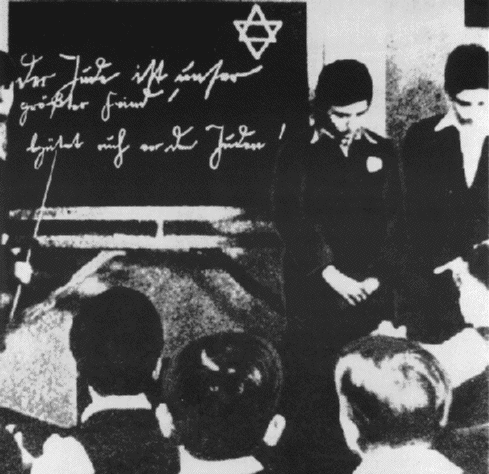
Jewish students being humiliated in class. The writing says, "The Jew is our greatest enemy. Beware the Jew!" (from Isurvived.org.)
Those very things then began to unfold. Jews were beaten and businesses vandalized. There was a nationwide boycott of these Jewish businesses in 1933. The Law for the Restoration of the Professional Civil Service was passed, banning all Jews from holding civil service jobs. Signs all over Germany were seen at villages, hotels, and restaurants, saying "Jews Not Wanted Here," and the like. The physical attacks increased, and Jews were publicly mocked. Men had their beards forcibly cut off. These were not always the actions of German soldiers or Nazi government officials or Hitler's SS, but the acts of ordinary Germans who were taking their cue from the vitriol expressed by the government and media. Over and over people were taught of the evil wickedness of the Jew and that their race was not human. The Nuremberg Laws of 1935 stripped the Jews of their citizenship that had come with Jewish emancipation, and Jews were forbidden to marry Germans. Finally, in 1938, the horrific Kristallnacht (Crystal Night) took place, and throughout Germany Jews were killed or beaten, their synagogues burnt, and the glass fronts of thousands of Jewish businesses were shattered. Although organized largely by the army, many German citizens participated and most were accepting of this destruction.

"Jews are not wanted here" (from U.S. Holocaust museum)

Kristallnacht (from the Telegraph.co.uk)
All Jews that could manage to leave the country did so. Their German neighbors treated them as outcasts or "lepers." Yet, the leadership in Germany continued to preach about the "Jewish problem," and the need to eliminate Jews from the country. Just how to do so was not readily apparent, although extermination was beginning to be discussed at the highest levels of government. By the beginning of World War II, in 1939, however, the children of German citizens themselves would point to how Germany could rid themselves of the Jewish plague. These little ones, though "human", would guide the Germans in their elimination of the Jewish "sub-humans", all with the aid of modern medical science. We will look at this program next week, known by a simple letter and a number--"T4."
Sunday, August 4, 2013
Not Quite Human
I would like to talk to you for the next several weeks about what it means to be a human. Certainly humans and lesser beings are both capable of suffering. God has given man dominion over the creatures that are not human (Genesis 9). As stewards of all that God has given us, we are to treat those things entrusted to us with respect. Humans, however, are due the highest regard. God gives life to man, and in that same chapter he states, "And for your lifeblood I will require a reckoning: from every beast I will require it and from man. From his fellow man I will require a reckoning for the life of man. Whoever sheds the blood of man, by man shall his blood be shed, for God made man in his own image" (vv. 4-6). This comes far before the law seen in Exodus, Leviticus, and Deuteronomy. The concept here is that man and man's life is special to God, and we are accountable to God for the preservation of man's life.
There are few alive today that can recall the Holocaust. I would imagine that if you stopped a young person on the street they would not recognize that time in the world's history. I have been blessed to visit the Holocaust Museum in Washington, D.C. as well as the one in Israel, and to have met and heard a Holocaust survivor speak while in Israel. I have just finished reading many writings on the Holocaust, and foremost among these is a book called Hitler's Willing Executioners by Daniel Jonah Goldhagen. The more you study it and delve into it, the more horrific it becomes. There is no point in the study of the Holocaust where you think to yourself, "Well, it wasn't as bad as I thought." Whatever you think you know about the Holocaust, the realities were much, much worse. Many of the things I wish to discuss with you about suffering on such a scale will be very unpleasant to read. As you read these things and feel uncomfortable, you must imagine them being done to you or your loved ones. They really happened. They are not fiction.
The development of a system to slaughter six to eight million human beings does not occur in short order. This week, I would like to show you how Germany got to the point where as a country these things could be carried out. And yes, I said "Germany", not "Hitler" or "the SS" or "the Nazis". In some way or another, nearly the entire population of a country condoned or participated in the extermination of millions of Jews.
After the destruction of Jerusalem in 70 A. D. by the Romans under the emperor Titus, Jews fled the Holy Land and dispersed throughout the world. Jews fled to other countries in the Middle East, to North Africa and Spain, and to Eastern Europe. This dispersion, or "diaspora", resulted in a large population of Jews in Poland, Russia, and other Eastern European countries, although many settled in Western Europe as well. Because of their unique religious beliefs, often living in Christian lands, they were never really fully assimilated into these countries and cultures, and in many lands they were not considered citizens. After the Fourth Council of the Lateran in 1215, the Catholic Church
required Jews to wear special clothing, or often yellow badges, to identify themselves as Jews. There were many restrictions placed on them. Many in the Church held the Jews responsible for the death of Christ, and anti-Semitism was widespread. For centuries, then, the Jews were identified, ostracized, and kept from fully realizing their identity as citizens of the countries wherein they lived.
In the late 1700's and up until the 1900's there were many movements to grant equality to the Jews. This was known as "Jewish Emancipation," and it occurred unevenly across Europe, one country or province at a time. The United States was actually the first country to give Jews equal rights, in 1789; the first country to do so in Europe was France in 1791. Individual German states gave Jews equal rights in the decades to follow, but the country as a whole did not do so until around 1870.
In the early 20th century, the tide turned against the Jews in Germany. Public opinion and the news media began to cast suspicion upon them. Much of this originated with the notions of race, genetics, and had its origins in Darwinian theory and eugenics. The Jews were felt to be a separate race, and an inferior one at that. After the disastrous defeat of Germany in World War I, the economy collapsed. Germany was in horrendous debt as the Treaty of Versailles called for enormous reparations. Unemployment and inflation were rampant. Somebody had to be responsible for all of this misery, and the Jews were identified as being the most responsible. There came to be a feeling that Jews were malicious, wicked, and full of evil impulses to control the economy. It was an unusual combination of sentiments; the Jews in Germany were felt to be a "subhuman" race, an "inferior" race compared to the German blue-eyed and blond-haired Aryan ideal, yet capable of extreme intelligence and cunning. So an inferior Jew could be quite intellectually capable.
Jews proved to be extremely adaptable to harsh conditions. Hardworking and intelligent, bound by religious codes of conduct, they became successful in many foreign lands. They did not typically invest in capital, land, and buildings that could be taken from them. Jews usually did not own factories and large farms. They learned skills that could be taken with them, such as medicine and law, so that when persecution came they could relocate more easily. They became experts at managing money and finance, and many became jewelers and diamond merchants, because you could pick up your precious stones and move quickly if need be.
That the Jews could do well in times of economic distress led many in Germany to despise them and hold them responsible for the poor conditions. The nature of fallen man is often to hate another's success, and to feel that the success of one somehow must mean that he has robbed the less fortunate. There is a linkage in the minds of many that simply cannot be broken, not that one fails and one succeeds, but that the failure of one is due to the success of another. The finger of one that fails is rarely pointed at himself.
These, then, are the roots of anti-Semitism. The notion of Jews as a despicable people, not fully human but "sub-human", capable of great evil and cunning, and responsible for the misery of the German people, was taught and preached and printed and broadcast at every opportunity. Words were not always necessary. The cartoons, drawings, and caricatures spoke volumes. Lies repeated endlessly become the truth. It takes only a generation for a new truth to be accepted. Only one generation of schoolchildren must be raised with a false teaching for that to become the new dogma.
Next week we will look at how a decades of characterizing the Jew led to demonizing the Jew, and how people began to treat the Jews. How we treat others is determined by how we think we should treat others. We treat humans differently than we do other creatures. When the Jew was determined to be something other than human, they were treated differently. As described in Goldhagen's book, a murderer of many Jews explained, "The Jew was not acknowledged by us to be a human being."
There are few alive today that can recall the Holocaust. I would imagine that if you stopped a young person on the street they would not recognize that time in the world's history. I have been blessed to visit the Holocaust Museum in Washington, D.C. as well as the one in Israel, and to have met and heard a Holocaust survivor speak while in Israel. I have just finished reading many writings on the Holocaust, and foremost among these is a book called Hitler's Willing Executioners by Daniel Jonah Goldhagen. The more you study it and delve into it, the more horrific it becomes. There is no point in the study of the Holocaust where you think to yourself, "Well, it wasn't as bad as I thought." Whatever you think you know about the Holocaust, the realities were much, much worse. Many of the things I wish to discuss with you about suffering on such a scale will be very unpleasant to read. As you read these things and feel uncomfortable, you must imagine them being done to you or your loved ones. They really happened. They are not fiction.
The development of a system to slaughter six to eight million human beings does not occur in short order. This week, I would like to show you how Germany got to the point where as a country these things could be carried out. And yes, I said "Germany", not "Hitler" or "the SS" or "the Nazis". In some way or another, nearly the entire population of a country condoned or participated in the extermination of millions of Jews.
After the destruction of Jerusalem in 70 A. D. by the Romans under the emperor Titus, Jews fled the Holy Land and dispersed throughout the world. Jews fled to other countries in the Middle East, to North Africa and Spain, and to Eastern Europe. This dispersion, or "diaspora", resulted in a large population of Jews in Poland, Russia, and other Eastern European countries, although many settled in Western Europe as well. Because of their unique religious beliefs, often living in Christian lands, they were never really fully assimilated into these countries and cultures, and in many lands they were not considered citizens. After the Fourth Council of the Lateran in 1215, the Catholic Church
required Jews to wear special clothing, or often yellow badges, to identify themselves as Jews. There were many restrictions placed on them. Many in the Church held the Jews responsible for the death of Christ, and anti-Semitism was widespread. For centuries, then, the Jews were identified, ostracized, and kept from fully realizing their identity as citizens of the countries wherein they lived.
In the late 1700's and up until the 1900's there were many movements to grant equality to the Jews. This was known as "Jewish Emancipation," and it occurred unevenly across Europe, one country or province at a time. The United States was actually the first country to give Jews equal rights, in 1789; the first country to do so in Europe was France in 1791. Individual German states gave Jews equal rights in the decades to follow, but the country as a whole did not do so until around 1870.
In the early 20th century, the tide turned against the Jews in Germany. Public opinion and the news media began to cast suspicion upon them. Much of this originated with the notions of race, genetics, and had its origins in Darwinian theory and eugenics. The Jews were felt to be a separate race, and an inferior one at that. After the disastrous defeat of Germany in World War I, the economy collapsed. Germany was in horrendous debt as the Treaty of Versailles called for enormous reparations. Unemployment and inflation were rampant. Somebody had to be responsible for all of this misery, and the Jews were identified as being the most responsible. There came to be a feeling that Jews were malicious, wicked, and full of evil impulses to control the economy. It was an unusual combination of sentiments; the Jews in Germany were felt to be a "subhuman" race, an "inferior" race compared to the German blue-eyed and blond-haired Aryan ideal, yet capable of extreme intelligence and cunning. So an inferior Jew could be quite intellectually capable.
Jews proved to be extremely adaptable to harsh conditions. Hardworking and intelligent, bound by religious codes of conduct, they became successful in many foreign lands. They did not typically invest in capital, land, and buildings that could be taken from them. Jews usually did not own factories and large farms. They learned skills that could be taken with them, such as medicine and law, so that when persecution came they could relocate more easily. They became experts at managing money and finance, and many became jewelers and diamond merchants, because you could pick up your precious stones and move quickly if need be.
That the Jews could do well in times of economic distress led many in Germany to despise them and hold them responsible for the poor conditions. The nature of fallen man is often to hate another's success, and to feel that the success of one somehow must mean that he has robbed the less fortunate. There is a linkage in the minds of many that simply cannot be broken, not that one fails and one succeeds, but that the failure of one is due to the success of another. The finger of one that fails is rarely pointed at himself.
These, then, are the roots of anti-Semitism. The notion of Jews as a despicable people, not fully human but "sub-human", capable of great evil and cunning, and responsible for the misery of the German people, was taught and preached and printed and broadcast at every opportunity. Words were not always necessary. The cartoons, drawings, and caricatures spoke volumes. Lies repeated endlessly become the truth. It takes only a generation for a new truth to be accepted. Only one generation of schoolchildren must be raised with a false teaching for that to become the new dogma.
Next week we will look at how a decades of characterizing the Jew led to demonizing the Jew, and how people began to treat the Jews. How we treat others is determined by how we think we should treat others. We treat humans differently than we do other creatures. When the Jew was determined to be something other than human, they were treated differently. As described in Goldhagen's book, a murderer of many Jews explained, "The Jew was not acknowledged by us to be a human being."
Subscribe to:
Posts (Atom)